


There are products you buy not just for the flavor, but for the story that flows through them. On Pag Island, that story is carved by the poetry of nature, history, and the generations who lived in symbiosis with this stone.
The founder of Sirana Gligora, Ivan Gligora, captured the very soul of this island in a few timeless, poetic lines:
Paški sir is the beleca (beauty) of sage and immortelle, wormwood and rockrose, gorse and wild fennel, salted by the storms of two bays, sought out among the babulji (stones) by Biliška and Mrkuša, Kaloka and Rogulja, Ćala and Pećara.
— Ivan Gligora
His son, Šime Gligora, continues his father's verses by explaining the secret recipe of Croatia's most famous indigenous cheese: "The bura wind, the sheep, the man. And the Island of Pag."
1. The Holy Trinity of Pag: Wind, Sheep, and Man
On Pag, only the strongest and most resilient survive. This barren karst is the result of a unique climate clash where the mild Mediterranean air meets the freezing continental climate of the Velebit mountain peaks.
- The Bura Wind (Capricious yet Essential): This powerful northern wind crashes down the slopes of Velebit. In the blink of an eye, it turns the sea's surface into a boiling mist of tiny droplets, drying them into sea-salt dust (posolica). The bura scatters this salt across the island from two bays: the Velebit Channel and Pag Bay. This salty dust acts like boiling water on weak vegetation. Only exceptionally hardy, aromatic plants like sage (slavulja), immortelle, wormwood, rockrose, and wild fennel survive, concentrating miraculous aromatic substances within themselves.
- The Pag Sheep (The Indigenous Warrior): Our sheep—affectionately named Biliška, Mrkuša, Ćara, Pećara, Rogulja, and Kaloka—have withstood the bura for centuries. They roam freely across the pastures, searching for these aromatic herbs hidden among the rocky terrain (babulji). Completely adapted to the island's harsh conditions, they gave man their wool, hide, meat, and ultimately—liquid gold for cheese.
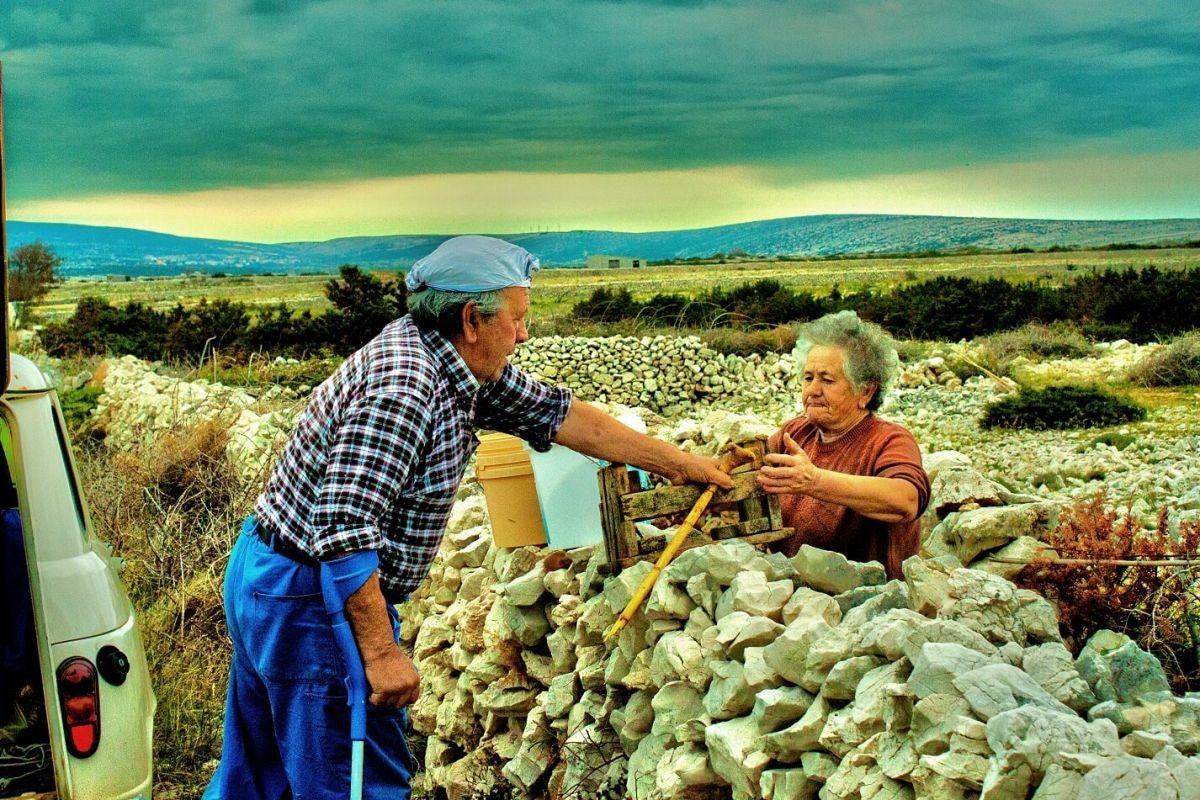
- The Man (The Dawn Struggle): Alongside the sheep, man managed to survive. But creating Paški sir—the true beleca (beauty) of Pag—is no easy feat. It is a history of waking up before dawn, building dry-stone walls, hand-milking, and daily cheese-turning in the cellar. A perpetual question remains: who is stronger—the bura, the island, the sheep, or the man?
2. A Millennia-Old History: From the Liburnians to Fortis
The tradition of cheesemaking on Pag is likely as old as sheep farming itself. The first shepherds on the island were the Liburnians, an Iliryan tribe who settled here around 800 BC. Even today, right above our village of Kolan, stands one of the best-preserved Liburnian dry-stone hillforts.
However, we owe the first official written record of this delicacy to the Italian travel writer Alberto Fortis. In his famous 1774 travelogue “Travels Into Dalmatia,” he noted that the most significant products of Pag were sea salt, sage honey, wool, and—cheese.
3. From Shepherds' Huts to the Hands of Women
Until the beginning of the 20th century, Pag cheese was produced out in the wilderness, far from the villages. Shepherds from Kolan lived and worked in stone huts built of dry-stone walls, known as stani. These were thatched with reeds from the nearby Kolan field. It was the men who tended to the sheep, milked them, and made the cheese on-site.
Everything changed at the turn of the 20th century:
- Pastures became private property.
- Owners enclosed their lands with massive dry-stone walls (suhozidi), which laced the hills like the famous Pag lace, dividing them into paths and narrow passes.
- Shepherds abandoned the stani huts and returned to the village of Kolan, and the art of household cheesemaking was proudly taken over by women.
It was during this time that Paški sir slowly but surely evolved from a simple food of survival into a highly prized market commodity and a crucial source of income for island families.
4. Guardians of Tradition in the Modern Era
We have come a long way from village households and the first agricultural cooperatives. Today, the vast majority of this limited, premium product is crafted in modern, registered facilities, such as our dairy in Kolan.
Gligora blends generations of guarded tradition with state-of-the-art technology, collaborating with over 200 subcontractors. Yet, despite modern machinery, the essence remains untouched. Every time you taste a piece of our cheese, you are tasting the exact same beleca that the Liburnians claimed from the stone, that Fortis praised in his journals, and that the bura wind and Pag sheep have faithfully created for centuries.


